Tarot history
A short history of tarot: where the cards came from
Tarot began as a card game in northern Italy. Its use for reading came centuries later.
Tarot is often described as ancient, secret and mystical. The documented story is more down to earth, and in some ways more interesting. This is a rough outline of where the cards came from, with the well-recorded parts kept apart from the legends. Dates from the early period are approximate.
A card game in northern Italy, 1440s
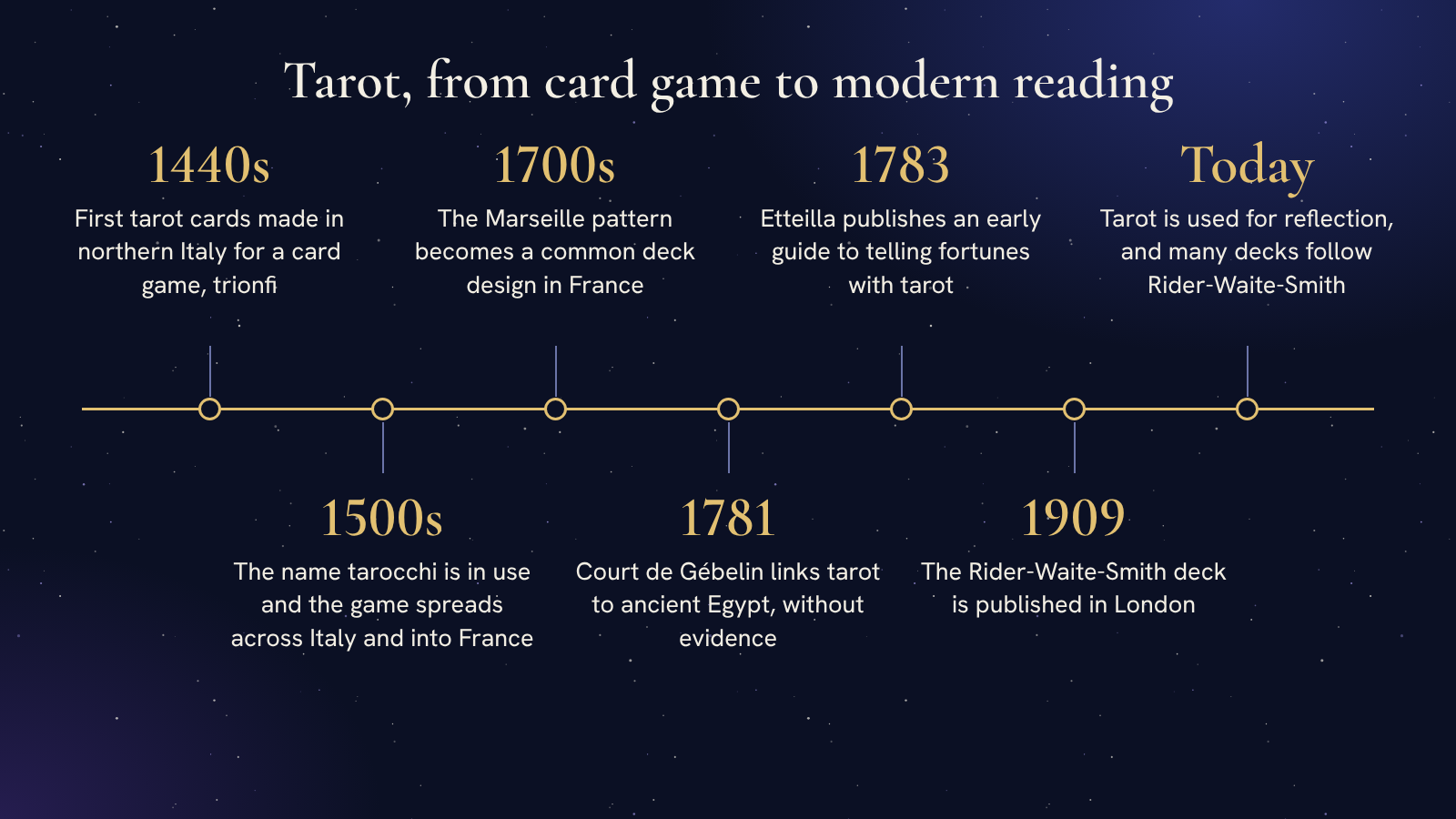
The earliest known tarot cards were made in northern Italy in the 1440s, in cities including Milan, Ferrara and Florence. They were called carte da trionfi, or triumph cards. Wealthy families commissioned hand-painted packs, and the Visconti-Sforza packs made for the ruling families of Milan are the best-known survivors.
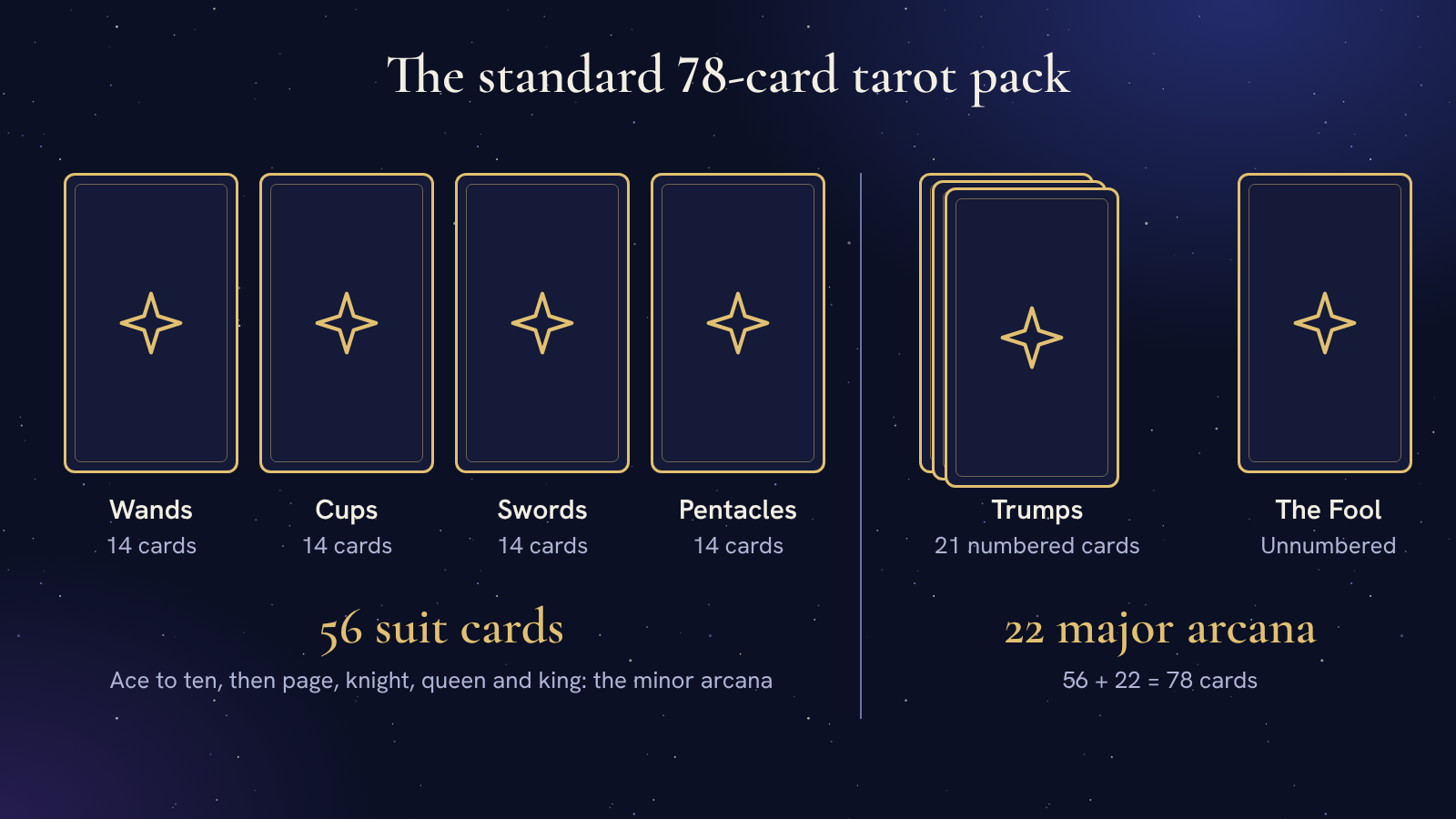
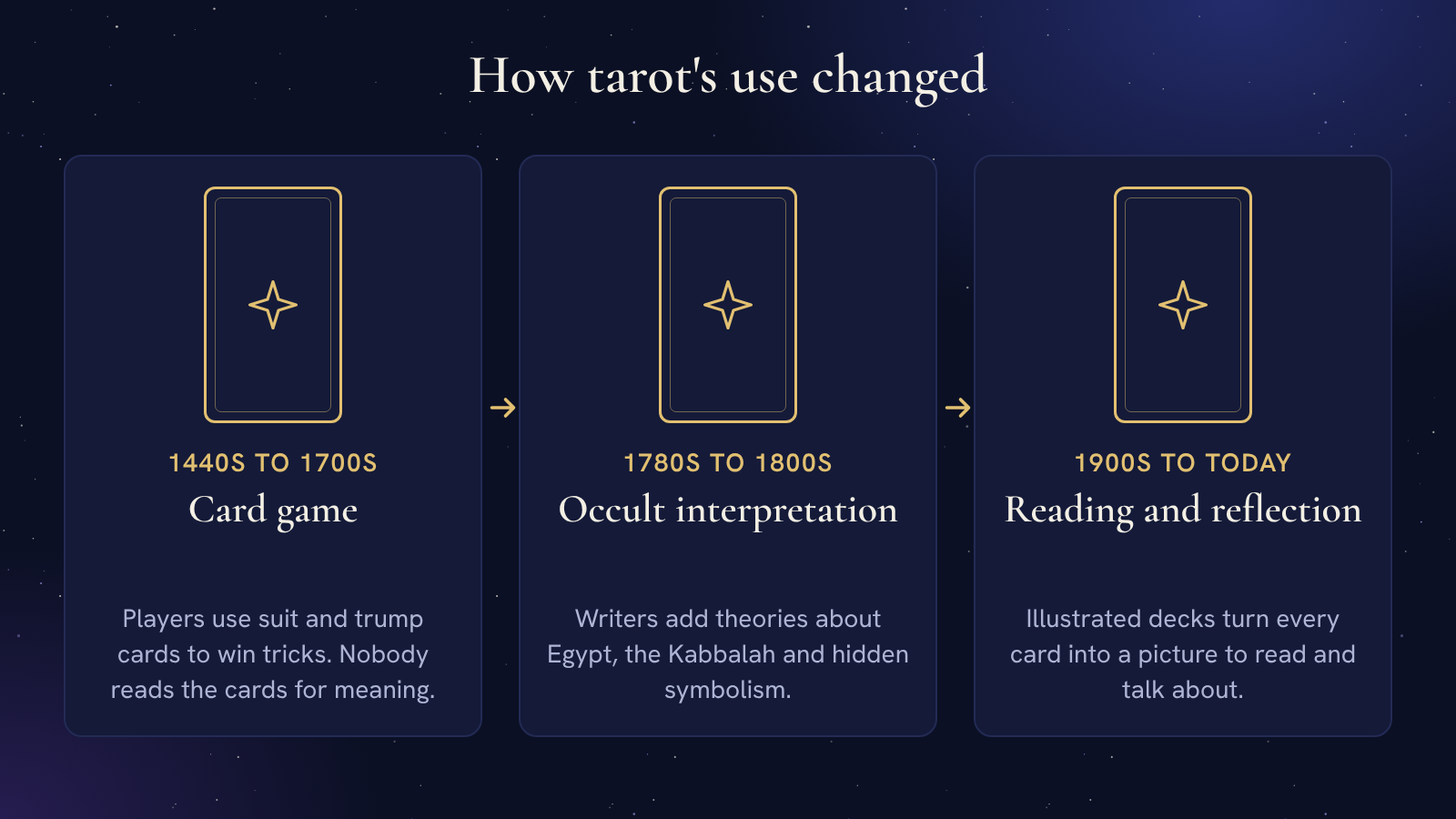
These packs added a run of extra picture cards, the trumps, to the four suits of ordinary playing cards, which had reached Europe in the late 1300s. The trumps beat the suit cards, which made for a new kind of trick-taking game. Nobody was reading meanings from the cards. They were being played.
From trionfi to tarocchi, 1500s to 1700s
By the early 1500s the name tarocchi was in use, and the game spread across Italy and into France and central Europe. The standard 78-card pack took shape over this period. In the 1600s and 1700s the Marseille pattern, a set of card designs produced in France, became one of the most widely copied. Card games played with tarot packs are still played in parts of Europe today, including France, Italy and Austria.
The Egypt story, 1780s
In 1781 a French writer, Antoine Court de Gébelin, claimed that the tarot trumps held the lost wisdom of ancient Egypt. There was no evidence for this. Playing cards did not reach Europe until centuries after Egyptian civilisation, and no link has ever been found. The idea caught on anyway and shaped how people thought about tarot for generations.
In 1783 a Parisian card reader who called himself Etteilla (Jean-Baptiste Alliette) published what is generally regarded as the first guide to using tarot for fortune telling. For the first time, the cards were being given set meanings.
The occult revival, 1800s
In the 1850s the French writer Éliphas Lévi linked the trumps to the Hebrew alphabet and to the Kabbalah, a tradition of Jewish mysticism. Later in the century, the Hermetic Order of the Golden Dawn, a secret society in Britain, built tarot into a system of study. Many of the symbols and correspondences people now associate with tarot come from this period rather than from the original game.
The Rider-Waite-Smith deck, 1909
The deck that shaped modern tarot appeared in London in 1909, published by the firm of William Rider and Son. It was designed by A. E. Waite, a Golden Dawn member, and illustrated by the artist Pamela Colman Smith. Older packs usually showed only repeated suit symbols on the number cards. Smith painted a scene on every one of the 78 cards, so each card became a small picture that could be read like a story. That made tarot far easier to learn, and most modern decks follow its layout. Smith's contribution was overlooked for decades and is now widely credited.
Other influential decks followed. The Thoth deck, designed by Aleister Crowley and painted by Lady Frieda Harris in the 1940s, was published in 1969.
Tarot today
Thousands of tarot decks now exist, and most follow the structure laid down in the fifteenth century: four suits, a set of trumps and The Fool. People use them to reflect on their own questions, to tell stories and to start conversations, usually through spreads that give each card a position.
Tarot has no demonstrated ability to predict events. Readings are for entertainment and reflection only, and they aren't medical, legal or financial advice.
Where to go next
If you are new to tarot, start with the guide to what a tarot spread is, or read the overview of tarot. When you have a spread in front of you, you can photograph it and read it card by card.