Tarot basics
Reversed tarot cards and how to read them
A reversed card is one that lands upside down in your tarot spread. You can read it as a twist on the card's theme, or leave reversals out entirely.
Sooner or later, a card in your tarot spread turns up upside down. This is called a reversed card. Some readers give reversed cards a meaning of their own, and some ignore the direction altogether. Both are valid, and this guide explains the common approaches so you can choose.
Upright and reversed
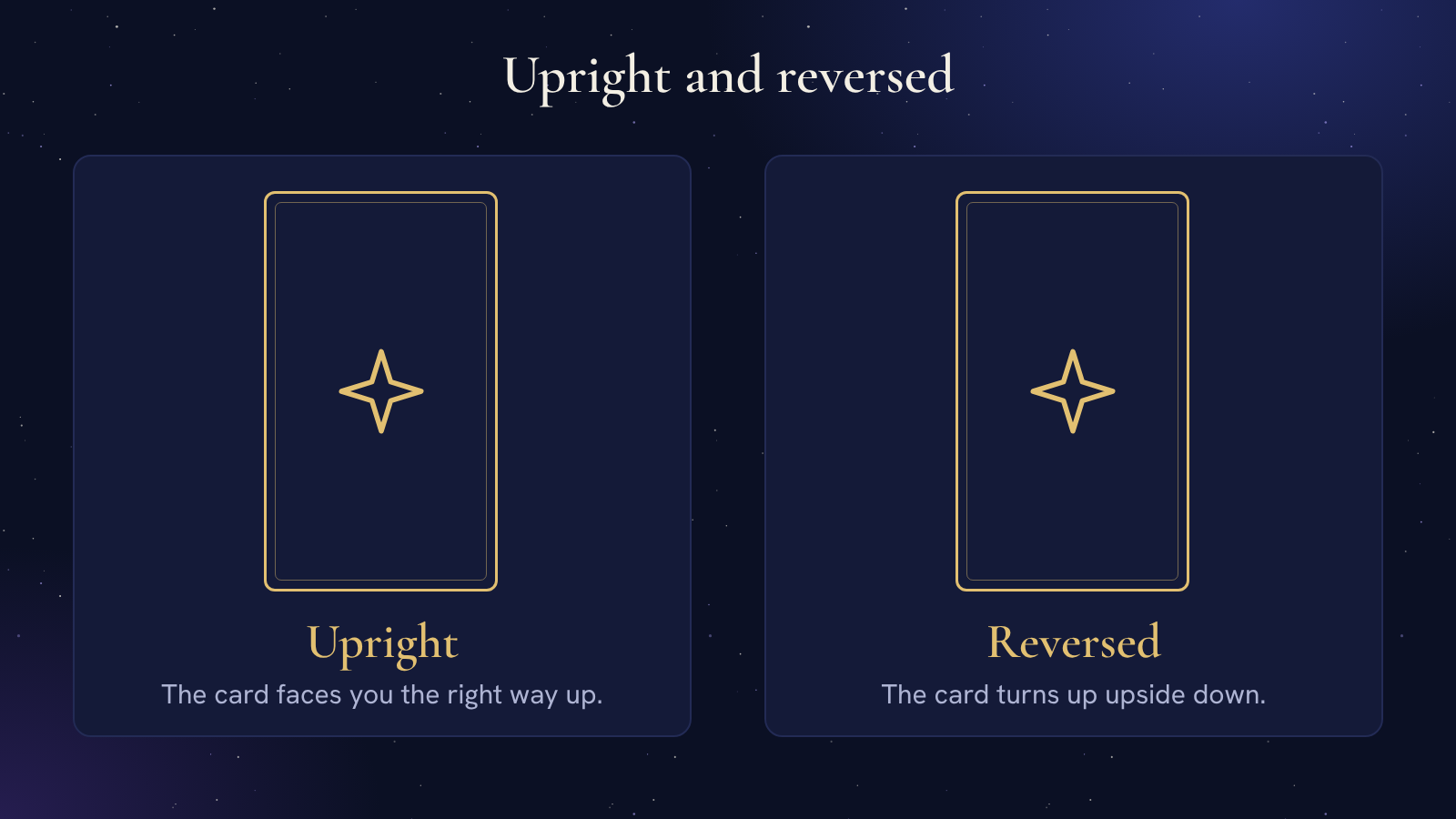
A card is upright when it faces you the right way up as you read it, and reversed when it is turned the other way. Reversals happen naturally when you shuffle by mixing cards in a pile, because some end up rotated. If you shuffle by riffling the deck, reversals may not occur at all unless you flip some on purpose.
Three ways to read a reversed card
There is no single rule, and different readers handle reversals differently. Here are the three approaches you will meet most often.
- The opposite. The card means the reverse of its upright sense. Strength upright is courage, and reversed it is self-doubt.
- A softer or blocked version. The card's energy is still there but is delayed, hidden or turned inward. This reads the same card with less force.
- A prompt to look closer. A reversed card is a flag that the card's theme needs attention. You ask what is in the way, or what is being overdone.
The first suits simple, quick readings. The second and third give more room to think, and they are the ones many people prefer.
Reading a reversed card step by step
- Recall the card's upright meaning first.
- Check the position, because the question it asks shapes the reversal.
- Pick one of the three approaches above and apply it.
- Look at neighbouring cards for hints about what is blocked or overdone.
Take The Sun, a card of warmth and clarity. Reversed in a present position, it might read as "good news is there, but something is dimming it", or as "I am looking for more certainty than I have".
Reversed cards are not bad cards
A common worry is that reversed cards mean bad news. That is not how they are generally read. A reversed card is a different angle on the same theme, and it often points to something you can work on. A reversed difficult card, such as The Tower, can even read as a change you are resisting, or one that is less sudden than it looks.
When to skip reversals
Plenty of readers never use them. Skipping reversals keeps a reading simpler, makes the cards easier to learn, and avoids the question of how to handle them. If you are new to tarot, it is reasonable to read every card upright until you are comfortable with the 78 cards. You can add reversals later.
Whichever you choose, decide before you begin and keep to it for the whole reading. Changing the rules midway tends to produce readings that suit what you hoped to see.
Tarot has no demonstrated ability to predict events. Readings are for entertainment and reflection only, and they aren't medical, legal or financial advice.
Where to go next
For how position and direction work together, see tarot card positions and what they change. If a photographed spread contains reversed cards, they are named as reversed in the reading, so you can see which way each one fell.