Tarot basics
Major and minor arcana in tarot, explained
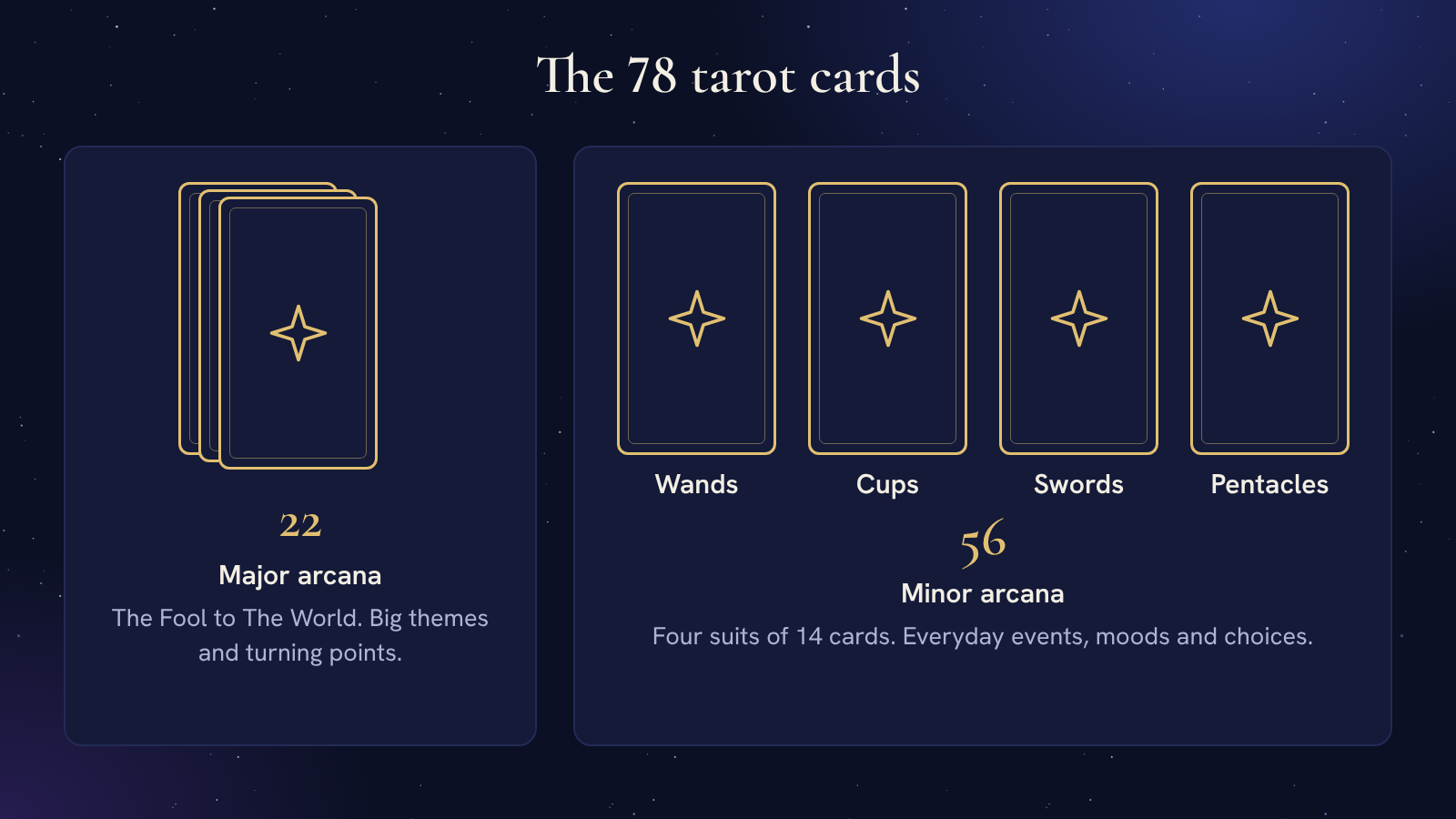
A tarot deck has 78 cards: 22 major arcana for big themes and 56 minor arcana for everyday life.
A standard tarot deck has 78 cards, split into two groups called the major arcana and the minor arcana. "Arcana" comes from a Latin word for secrets, but in practice the split is simple: the major arcana are the big picture cards, and the minor arcana are the everyday ones. Knowing which is which helps you read any tarot spread.
The major arcana: 22 cards
The major arcana are 22 cards numbered from 0 to 21. They begin with The Fool, numbered 0, and end with The World, numbered 21. In between are cards such as The Magician, The Lovers, Death, The Star and The Sun. Each one carries a named figure or idea, and many readers see them as stages in a journey from beginning to completion.
In a spread, a major arcana card usually points to something larger: a turning point, a lasting theme or a lesson. When several turn up together, many readers take it as a sign that the question touches something significant.
The minor arcana: 56 cards
The minor arcana are the 56 cards that look most like a regular playing deck. They come in four suits of 14 cards:
- Wands are linked with energy, ambition and action.
- Cups are linked with feelings, relationships and imagination.
- Swords are linked with thought, communication and conflict.
- Pentacles are linked with work, money and the material world.
Each suit runs from Ace to Ten, then adds four court cards: Page, Knight, Queen and King. Different decks sometimes rename the suits or court cards, so your deck may differ slightly. Together the four suits make 56 cards, and 56 plus 22 makes 78.
How they read differently
Major cards read as themes and turning points. Minor cards read as events, moods and choices in daily life. A minor card might describe a stressful week, while a major card suggests a change that could last for years.
The balance of a spread can also tell you something. A spread full of minor cards often reads as a practical, everyday matter. One heavy with major cards suggests the question carries more weight than it first seemed to.
The court cards
The four court cards in each suit are usually read as people, either someone in your life or a side of yourself, though some readers read them as situations. The Page often stands for a beginner or a message, the Knight for movement, the Queen for inner mastery and the King for outward mastery.
Learning the 78 cards
You don't need to memorise them all before you begin. Start with the major arcana, because they are the most distinctive, then learn one suit at a time. Over the coming weeks, this section will cover every card in turn. Describing what you see on a card is a good way to learn it, and many decks make that easy because each of the 78 cards carries a picture.
Tarot has no demonstrated ability to predict events. Readings are for entertainment and reflection only, and they aren't medical, legal or financial advice.
Where to go next
For where the 78-card pack came from, read the short history of tarot. To see how the cards are used, read what a tarot spread is.