Tarot spreads
The astrological twelve-house tarot spread
The twelve-house tarot spread places twelve cards in a ring, one for each area of life. It borrows astrology's structure but needs no knowledge of astrology.
The twelve-house tarot spread lays out twelve cards in a ring, one for each area of life. It borrows its structure from astrology, where a chart is divided into twelve houses, but you do not need to know any astrology to use it. Think of it as a tidy way to take stock of your whole life at once, with a tarot card prompting reflection on each part.
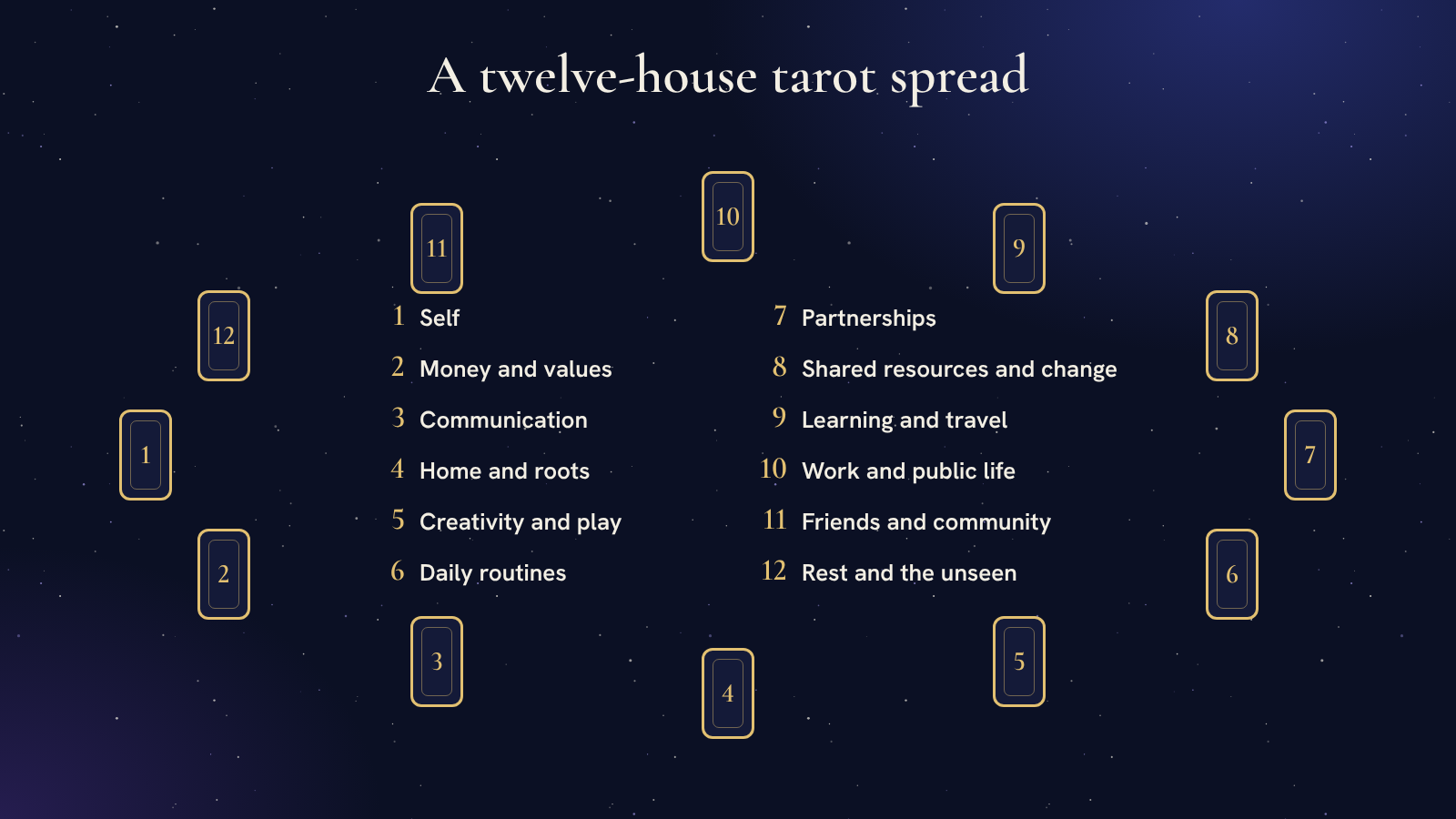
Where the layout comes from
In astrology, a birth chart is a circle divided into twelve sections called houses, each associated with a theme such as home, work or relationships. The tarot version uses the same wheel without the planets or signs. Cards are numbered 1 to 12 and, in many guides, placed anticlockwise, starting from the left side of the circle. If your guide runs the other way, follow it, and just stay consistent.
The twelve positions
- Self. How you see yourself and how you come across.
- Money and values. What you earn, own and care about.
- Communication. Everyday conversation, writing and learning close to home.
- Home and roots. Family, place and where you feel grounded.
- Creativity and play. Hobbies, joy and self-expression.
- Daily routines. Habits, tasks and the rhythm of ordinary days.
- Partnerships. Close one-to-one relationships.
- Shared resources and change. What is held jointly, and deeper transitions.
- Learning and travel. Study, beliefs and widening your view.
- Work and public life. Career, reputation and long-term aims.
- Friends and community. Groups, networks and shared hopes.
- Rest and the unseen. Solitude, recovery and what sits below the surface.
Some astrologers describe the houses a little differently, so you may see slightly different labels elsewhere. The list above is a practical version for tarot.
Setting up the reading
Choose a general question such as "What is the state of my life right now?" or "Where could I give attention this season?" Shuffle, then deal twelve cards in the ring. Turn them over one at a time in numerical order, or turn them all and take a first look at the whole before settling into the details.
Reading the wheel
Start by reading each card against its house, and keep it brief. Then step back and look at the circle as a whole:
- Which suit dominates? Lots of Swords could suggest a mind-heavy season, while many Cups may point to feelings.
- Where are the major arcana? These tend to mark areas that feel weighty or significant to you.
- Which houses sit opposite each other? Houses 1 and 7, 4 and 10, or 6 and 12 sit across the ring. It can be interesting to ask how the two cards speak to each other, for example home and work, or routine and rest.
Do not feel obliged to find something dramatic in every house. Often several cards will simply say that an area feels settled, and that is worth noticing too.
Using the reading
A twelve-card reading can be a lot of information. Pick one or two houses to focus on afterwards and write a line about what you want to do or notice there. Coming back to the same spread after a few months is a good way to see what has shifted in your own thinking.
Tarot has no demonstrated ability to predict events. Readings are for entertainment and reflection only, and they aren't medical, legal or financial advice.
Where to go next
If you like the idea of one card per month instead of per life area, try the year-ahead tarot spread. For a smaller overview, the mind, body and spirit tarot spread uses three cards. When you have laid out your own ring of twelve, you can photograph the tarot spread and have it read.