Tarot spreads
The mind, body and spirit tarot spread
The mind, body and spirit tarot spread is a three-card check-in on your thoughts, your daily energy and your sense of meaning. It is for reflection, not health advice.
The mind, body and spirit tarot spread is a three-card check-in. Instead of asking about a particular decision, it asks how you are doing across three areas of life: your thoughts, your day-to-day energy, and your sense of meaning. It takes a few minutes and works well as a weekly or monthly pause.
The three positions
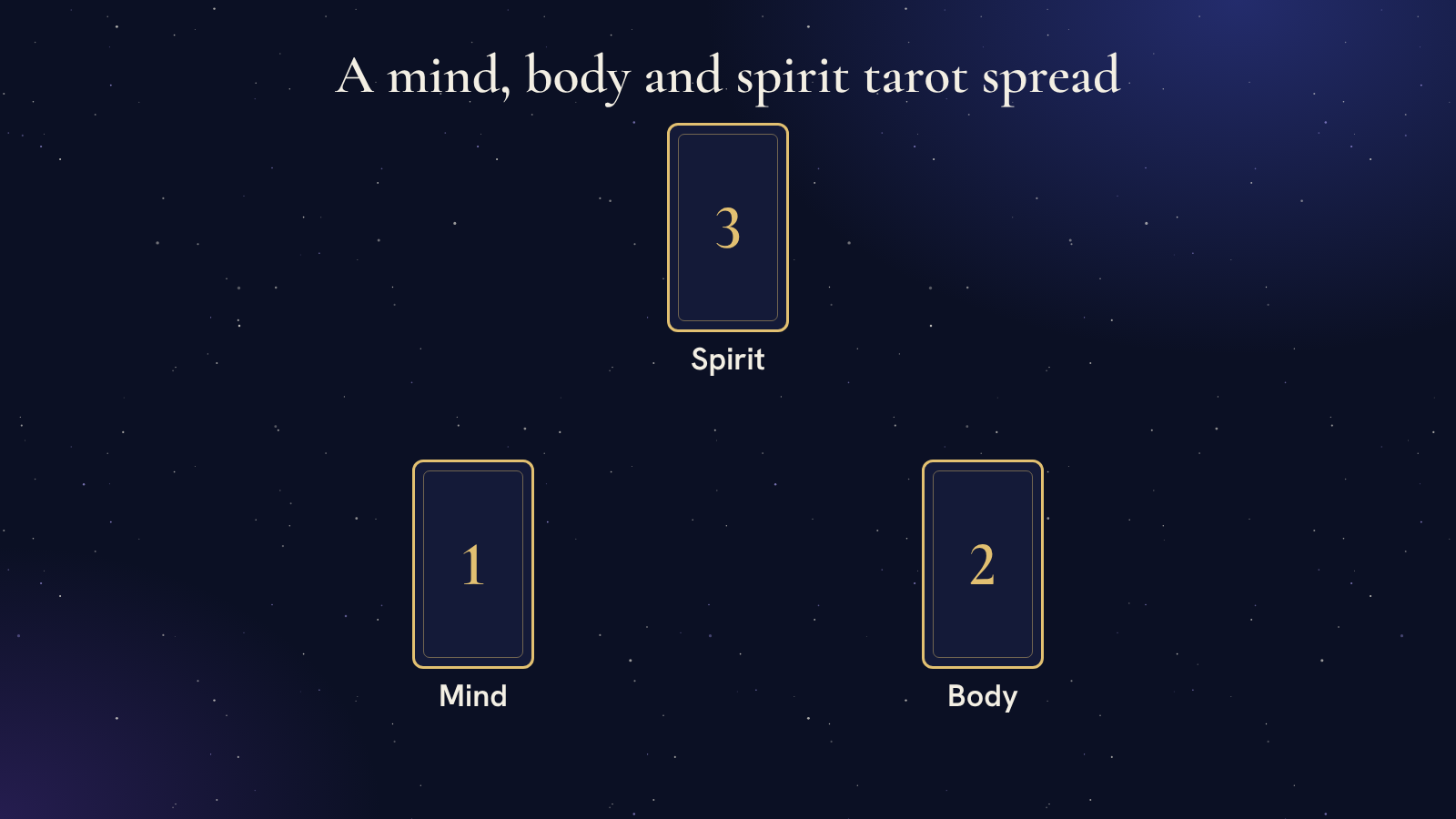
- Mind. What you have been thinking about, the stories you are telling yourself, and what is taking up headspace.
- Body. Your energy and the practical side of daily life: routines, rest, pace and what you are doing with your time.
- Spirit. What gives things meaning for you: your values, hopes and sense of direction. This does not need to be religious.
How to lay it out
Arrange the cards in a triangle. Place card 1, Mind, at the lower left and card 2, Body, at the lower right. Card 3, Spirit, goes at the top, centred above the other two. Turn over the cards in numbered order, then step back and look at the whole shape before reading each one.
A note on the body position
The Body card is about energy and daily practicalities, such as how you are pacing yourself or whether your routines suit you. It is not a health reading. Tarot cannot diagnose anything or tell you about your physical condition, and nothing in this spread replaces advice from a doctor or other qualified professional. If you are worried about your health, speak to one.
Reading the three together
The most useful part of this spread is often the relationship between the cards rather than any single card. A few questions to ask:
- Which card feels loudest? That is often the area asking for attention.
- Do the cards agree? A busy Mind card beside a still Body card might suggest your thoughts are running ahead of your energy.
- What does the Spirit card ask of the other two? Because it sits at the top, it can act as a reminder of what the rest is for.
Try not to label cards as good or bad. A difficult-looking card in the Mind position, such as the Three of Swords, can simply be naming a worry you have been avoiding. Naming it is the useful part.
A worked example
Imagine you draw the Seven of Swords for Mind, the Four of Wands for Body and the Star for Spirit. You might read Mind as a nagging sense of having to be careful or strategic, Body as a prompt to look at whether your home or routines feel settled, and Spirit as a gentle nudge towards hope and openness. Another reader might see something quite different, which is fine. The aim is to leave with one or two honest observations you can act on.
Making it a habit
Many people use this spread at the start of each month and write a sentence about each card in a journal. Looking back over several months can show patterns, such as the same suit appearing in one position again and again. Keep your notes short and descriptive so you are recording your reflections rather than trying to predict anything.
Tarot has no demonstrated ability to predict events. Readings are for entertainment and reflection only, and they aren't medical, legal or financial advice.
Where to go next
If three cards feel like a good fit, the classic three-card spread is worth a look, as is the one-card spread for a quicker daily version. Once your cards are down, you can photograph the spread and have it read for you.