Tarot spreads
The moon phase tarot spread
The moon phase tarot spread uses eight cards, one for each phase of the lunar cycle. The phases work as a metaphor for starting, building, seeing and releasing.
The moon phase tarot spread uses eight cards, one for each stage of the lunar cycle, from new moon to waning crescent. It suits people who like to think in cycles: starting something, building it, seeing it clearly, then letting it go. The moon does not affect events, so the phases serve as a metaphor, a familiar rhythm to hang your reflection on.
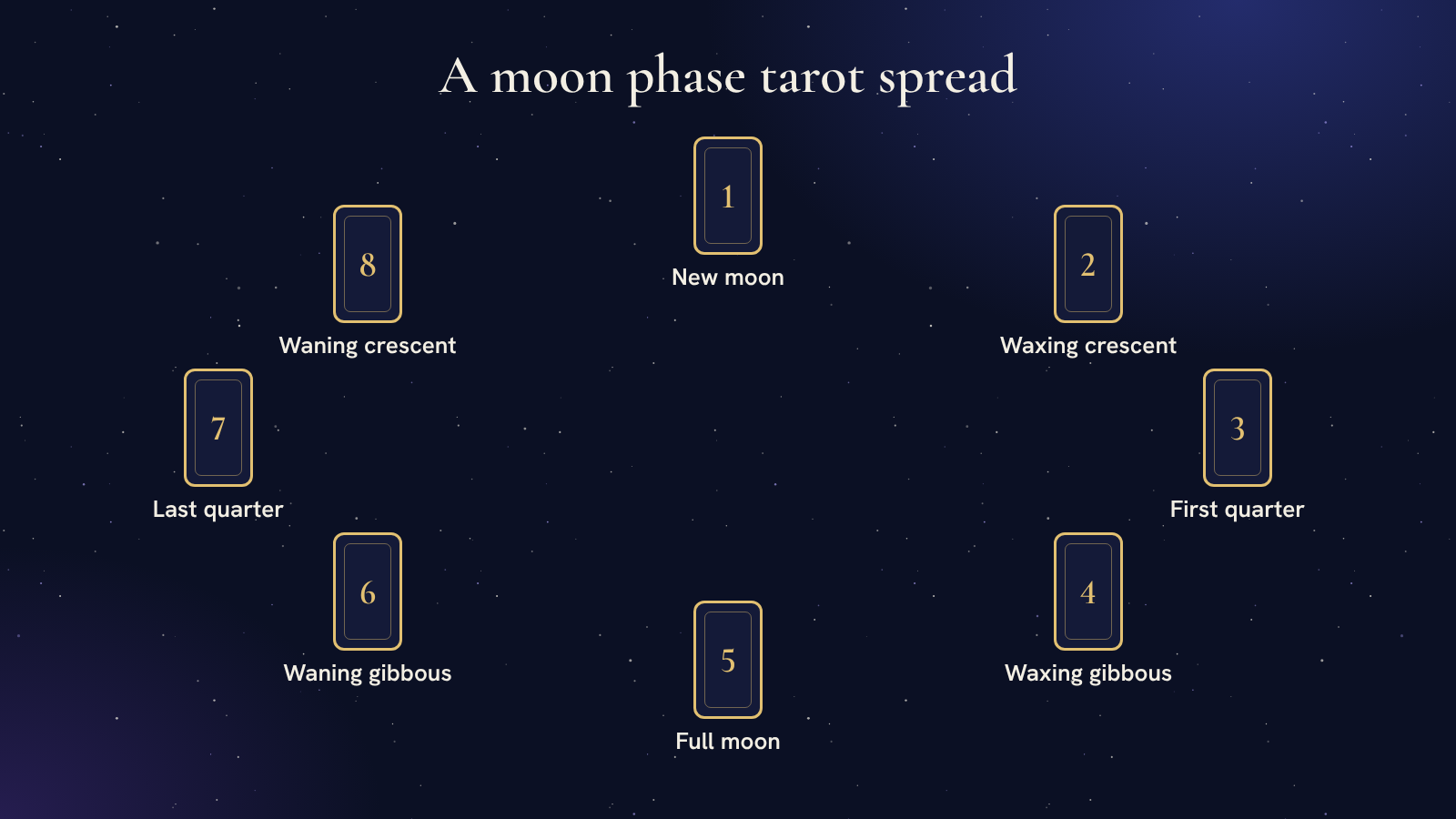
The eight positions
- New moon. Seeds and intentions. What are you beginning, or wanting to begin?
- Waxing crescent. First steps. What is the earliest action you could take?
- First quarter. A decision or obstacle. What needs a choice, or what is pushing back?
- Waxing gibbous. Refining. What could be adjusted or improved?
- Full moon. What is visible. What has come into the light?
- Waning gibbous. Sharing what you learned. What could you pass on, or put to use?
- Last quarter. What to release. What is ready to be set down?
- Waning crescent. Rest. What needs quiet before a new cycle?
Laying it in a ring
Place the cards in a circle, with the new moon at the top and the rest following clockwise, like a moon calendar. Any starting point works as long as the order stays consistent. A ring also gives you a visual cue that the cycle returns to its beginning: the rest of the waning crescent leads back to a new moon.
Using it in a single sitting
Most people lay the full spread in one session. You might choose a question such as "How could I move a project from idea to completion?" and read the eight cards as a story with a beginning, a middle and an end. Notice where the energy seems to rise and where it falls. If the full moon card is a difficult one, ask what is being made visible and whether that is useful to know.
Using it across a month
The lunar cycle takes about 29.5 days, so the eight phases span roughly a month. Some people turn it into a slow practice. They draw a card at each phase as it arrives, write a few lines, and look back at the full set at the end. The benefit is that you check in on a project over weeks, rather than reading it all at once. If you do this, check an almanac or calendar for the phase dates, because the exact days change each month.
Choosing a question
The spread works best with something that has a natural arc: a project, a habit you are building, a course of study, or a season of life you are moving through. Questions about a single moment, or about what another person will do, fit it poorly. If you are unsure, try "What would help me carry this from idea to finish?" and let the phases give shape to the answer.
What to look for
- The turning point. The full moon is the midpoint. Compare what comes before with what follows, and ask what changed.
- Release and rest. Cards 7 and 8 are about letting go and recovering. A busy card in the rest position can suggest you find it hard to stop.
- Echoes. If the same suit shows up at the start and the end, ask what is coming round again.
Tarot has no demonstrated ability to predict events. Readings are for entertainment and reflection only, and they aren't medical, legal or financial advice.
Where to go next
For another spread built around time, try the year-ahead tarot spread. The Moon card itself is covered in the Devil to the Moon. If you lay out the moon phase tarot spread yourself, you can photograph it and have it read.