Tarot spreads
The pyramid tarot spread
The pyramid tarot spread builds from a base of three cards to a single card at the top. It suits questions about what to do next.
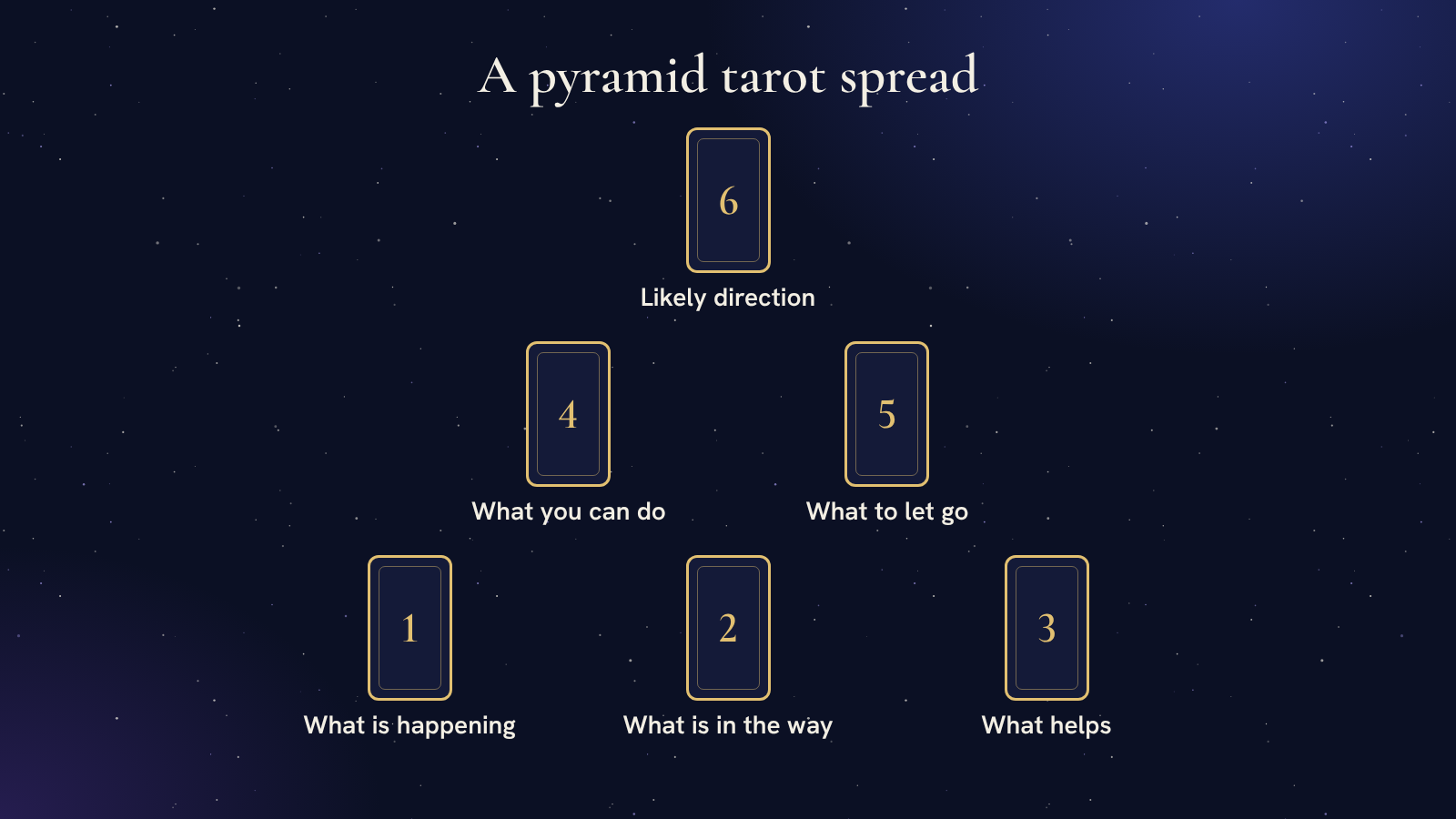
The pyramid tarot spread uses six cards in a triangle. Three cards form the base, two sit above them and one caps the top, so the reading builds from what is happening now towards a likely direction. It suits questions where you want both a picture of the situation and something practical to do about it.
The six positions
Read the base row first, left to right, then work upward.
- What is happening. The honest picture of the situation as it stands.
- What is in the way. The obstacle, habit or worry that is slowing things down.
- What helps. A strength, resource or support you already have.
- What you can do. A practical step within your own control.
- What to let go. An assumption, expectation or pattern that may no longer serve you.
- Likely direction. Where things may head if you carry on as you are. It is a tendency to consider, not a forecast.
How to lay it out
Place cards 1, 2 and 3 in a row along the bottom, with a little space between them. Put card 4 above the gap between 1 and 2, and card 5 above the gap between 2 and 3. Finish with card 6 centred above the middle row. The stepped shape makes the logic easy to see: each row narrows as it moves toward the point.
Reading the layers
Start with the base as a set. Cards 1, 2 and 3 describe the ground you are standing on: the situation, the friction and the support. Before moving on, ask whether they agree with each other or pull in different directions. A heavy, tense card in position 2 beside a gentle card in position 3 tells a different story from two difficult cards in a row.
The middle row is where the spread becomes practical. Position 4 asks what you can do, and position 5 asks what to release. Many readers find these two work as a pair: one thing to start or continue, one thing to put down. If card 4 suggests action but card 5 points to rest, that tension is worth writing down rather than resolving quickly.
The top card is a summary rather than a verdict. Read it against the cards beneath it. If the direction card feels out of step with everything below, look at which position it contradicts and let that guide a follow-up question.
A worked example
Suppose you are considering whether to go back to study. You might draw the Eight of Pentacles for what is happening, the Five of Swords for what is in the way, and the Three of Cups for what helps. Taken together, the base could suggest steady work, some inner conflict about it, and a community that could back you. Position 4 might bring the Ace of Wands, a prompt to take a first small step, and position 5 the Four of Swords, hinting that exhaustion might be worth releasing or resting. These are only prompts: your own reading of the imagery matters more than any list of meanings.
Questions that suit the pyramid
- How can I approach a big project that feels stuck?
- What would help me through a change at work or home?
- What is holding me back from something I want to try?
Avoid questions that ask for a fixed outcome. The pyramid works best when the question is about your own choices and approach.
Tarot has no demonstrated ability to predict events. Readings are for entertainment and reflection only, and they aren't medical, legal or financial advice.
Where to go next
If you want a smaller layout first, try the one-card spread, or read how card positions change a reading. Once your pyramid is laid out, you can photograph it and have it read card by card.