Tarot spreads
The Tree of Life tarot spread
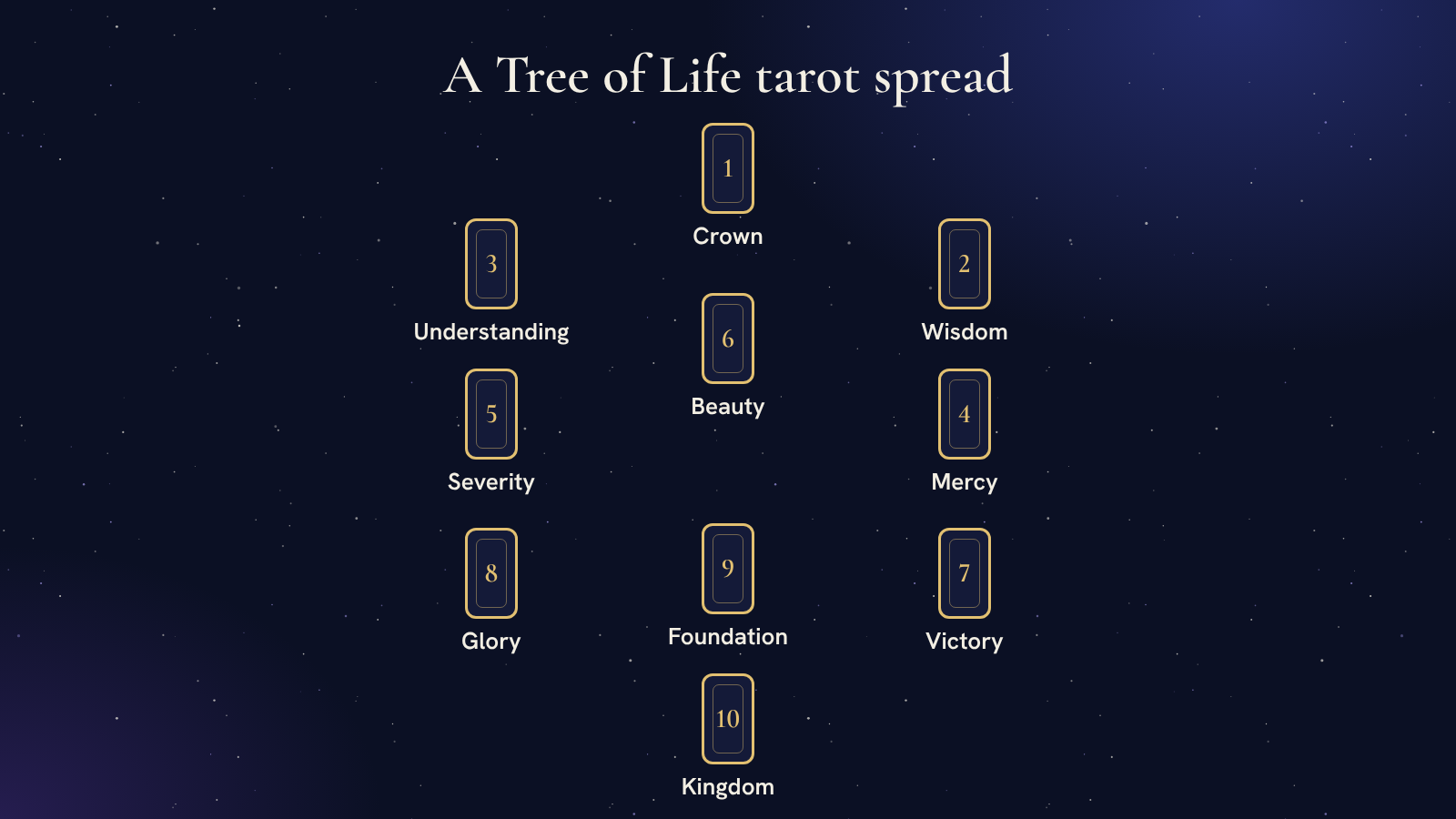
The Tree of Life tarot spread arranges ten cards on the Kabbalistic tree. Each position becomes a plain question, read from the practical present up to the highest aim.
The Tree of Life tarot spread places ten cards in the pattern of the Kabbalistic tree, a diagram from Jewish mystical tradition that was later adopted by the Golden Dawn, a late nineteenth-century occult society that influenced the Rider-Waite-Smith deck. You do not need to know Kabbalah to use the spread. Here the ten points on the tree become ten plain questions about a situation, from your highest aim down to the practical present.
How the cards are laid out
The tree has three vertical columns. Card 1 sits at the top centre, with 2 on the upper right and 3 on the upper left. Cards 4 (right) and 5 (left) sit lower, with 6 in the centre. Cards 7 (right) and 8 (left) come next, then 9 at the low centre and 10 at the bottom centre. Because the arrangement is about balance between the two sides, it helps to lay it out neatly before turning anything over.
The ten positions
Each position carries a traditional Hebrew name, shown in brackets. The names are optional, and the questions are what you read from.
- Crown (Kether). What is the highest aim here?
- Wisdom (Chokmah). What is the drive or impulse behind it?
- Understanding (Binah). What structure or form does it need?
- Mercy (Chesed). Where is there generosity and room to grow?
- Severity (Geburah). What limits or discipline apply?
- Beauty (Tiphareth). What brings balance? This is the centre of the matter.
- Victory (Netzach). What persistence and desire are at work?
- Glory (Hod). How are thought and communication involved?
- Foundation (Yesod). What habits and subconscious patterns sit underneath?
- Kingdom (Malkuth). What does the practical present look like?
Reading from the root upward
Many readers begin at the bottom with the Kingdom, the here and now, and work upward toward the Crown. This mirrors the idea of starting with what is real and practical, then moving through habits, drives and values toward an aim. Reading top down is equally valid if you prefer to start with the aim and see how it translates into daily life. Pick one direction and say it aloud before you start.
Looking at pairs and pillars
The layout invites comparison. The right column (2, 4, 7) leans toward energy and expansion, and the left column (3, 5, 8) toward form and restraint. Compare cards 4 and 5, or 7 and 8, and ask how they balance. Card 6 sits where the two sides meet, so it often works as the heart of the reading. Reading it last, after you have taken in the others, can help.
A note on depth
The Tree of Life carries centuries of symbolism, and people write whole books on it. For a first reading, keep it simple. Treat each position as a question, read the card against it, and write one sentence per card. If you want to go further later, you can study the tree separately, but the spread works well without it.
Tarot has no demonstrated ability to predict events. Readings are for entertainment and reflection only, and they aren't medical, legal or financial advice.
Where to go next
Ten cards is a lot, so you may want to start with the Celtic Cross tarot spread, which is a more common layout of the same size. For the thinking behind positions, read tarot card positions and what they change. You can photograph your own tarot spread and have it read card by card.