Tarot spreads
The horseshoe tarot spread
The horseshoe tarot spread arranges seven cards in an arch. It looks at the past, the present, hidden influences, you, others, advice and a likely direction.
The horseshoe tarot spread uses seven cards arranged in an arch, like a horseshoe. It sits between the three-card spread and the Celtic Cross: more detail than the first, less to manage than the second. It is a good choice when a question has a few moving parts and you want to look at yourself, other people and a possible way forward.
The seven positions
Cards are laid from left to right along the arch, so the first card sits at the lower left and the seventh at the lower right.
- Past: what led up to the situation.
- Present: where things stand now.
- Hidden influences: what is working beneath the surface or is not yet obvious.
- You (and obstacles): your stance, and what is in your way.
- Others and surroundings: people and circumstances around you.
- Advice: an approach to consider.
- Likely outcome: where it may head if things continue as they are.
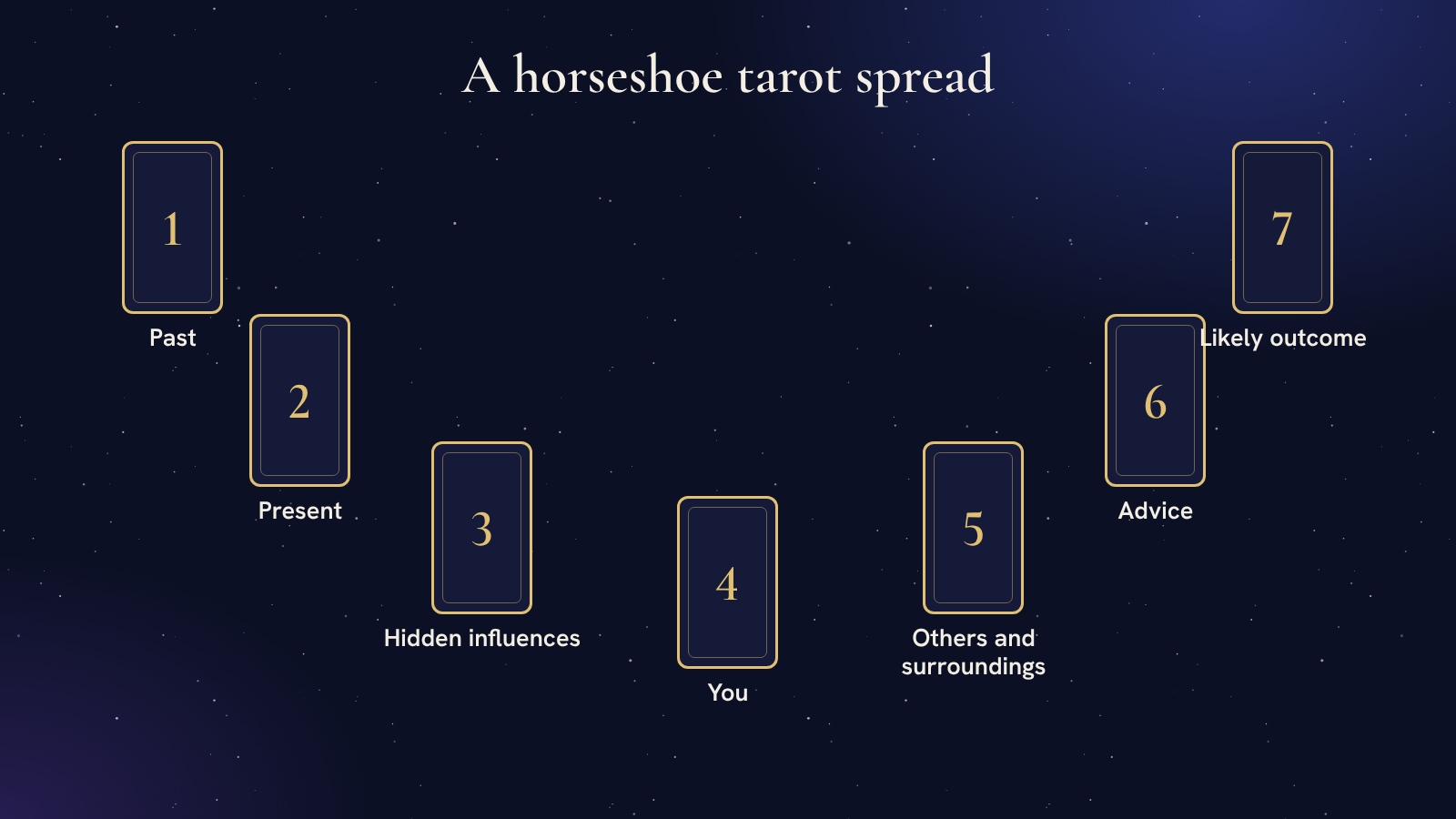
How the arch reads
The shape helps with interpretation. The first two cards set the scene. The middle cards, at the top of the arch, are the most complex: they hold what is hidden, your own part and the influence of others. The last two cards bring you down the other side, with advice and a likely direction.
Because the advice card comes just before the outcome, many readers look at them as a pair: what you might do, and what that could lead to.
A worked example
Suppose the question is "What should I understand about being asked to lead a project at work?" Imagine the cards come out as follows.
- Past: Eight of Pentacles, years of building skills.
- Present: Two of Wands, weighing options.
- Hidden influences: The High Priestess, an instinct not yet voiced.
- You and obstacles: Five of Swords, a worry about conflict.
- Others: Three of Cups, a supportive team.
- Advice: Strength, patience and quiet confidence.
- Likely outcome: The Sun, openness and clarity.
One reading might be that the reader has the skill and support, but an unspoken concern about conflict is holding them back. The advice card suggests meeting it calmly. A different reader could emphasise other connections, and that is part of how tarot works.
The horseshoe also suits questions that are not about a decision at all. You might use it to understand a recurring pattern, such as why a certain kind of conflict keeps returning, or to look at a season of life as it begins. In those cases the advice card is often the most useful, because it turns the reading into something you can act on.
Tips for the horseshoe
- Treat card 3 as a question. "Hidden" does not mean sinister. It can be something you have simply not looked at yet.
- Separate 4 and 5. It helps to notice what belongs to you and what belongs to the situation.
- Read the outcome gently. It shows a direction, not a fixed future. If you dislike it, the advice card is the place to look.
Tarot has no demonstrated ability to predict events. Readings are for entertainment and reflection only, and they aren't medical, legal or financial advice.
Where to go next
If you like having an advice position, the two-path decision tarot spread builds one into a choice between options. For a bigger layout, see the Celtic Cross tarot spread explained. When your seven cards are down, you can photograph the spread and have it read.