Tarot spreads
The two-path decision tarot spread
The two-path decision tarot spread compares two options by asking what each offers and what each asks of you. It does not choose for you.
The two-path decision tarot spread is built for the moment when you are weighing two options and want to see each clearly. It does not ask the cards to choose. Instead it gives each path its own pair of cards, one for what it offers and one for what it asks of you, so you can compare them side by side.
The six positions
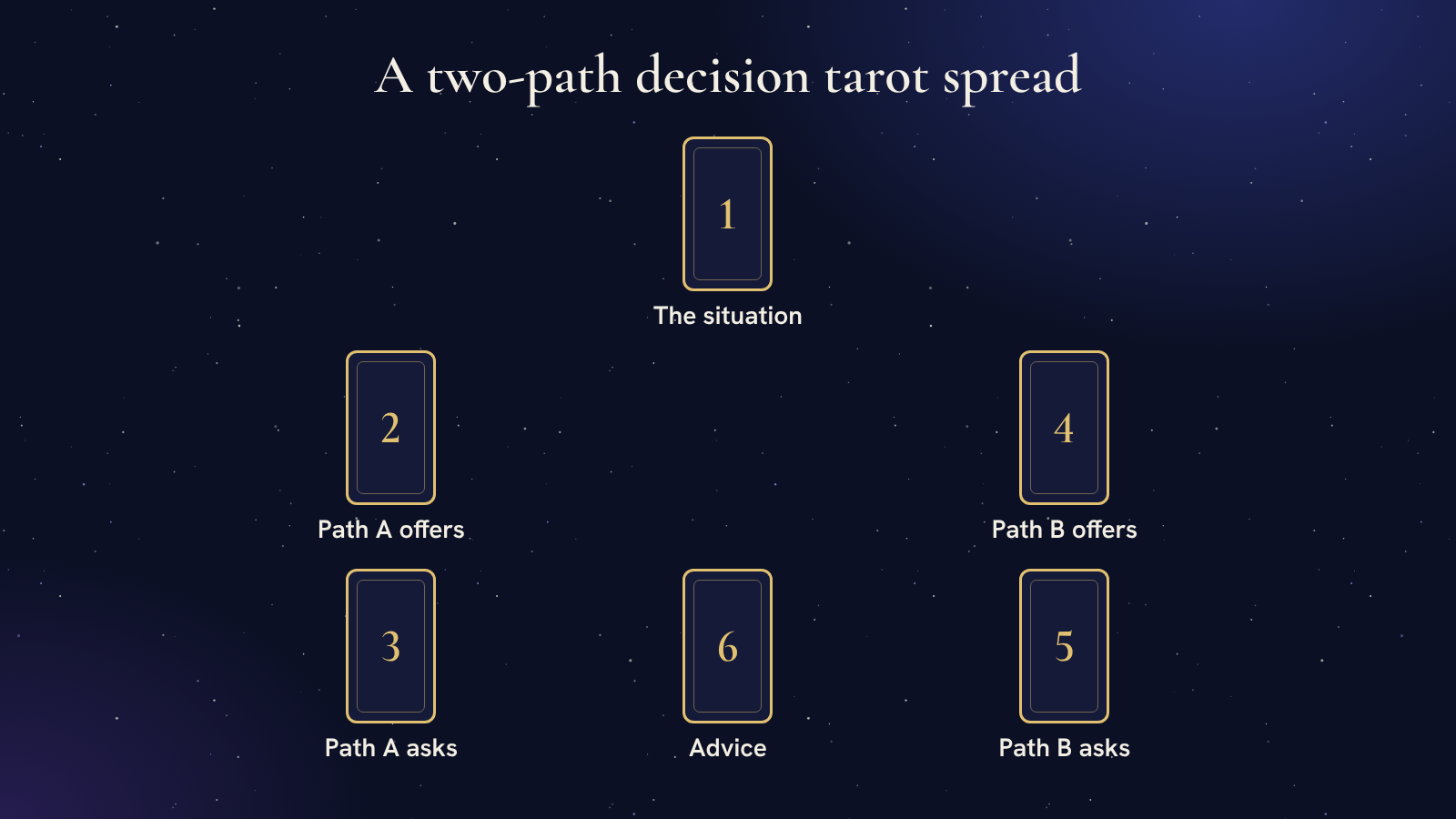
- The situation: where you stand now, at the top centre.
- What path A offers: the possible benefits of the first option.
- What path A asks of you: the effort, cost or change it involves.
- What path B offers: the possible benefits of the second option.
- What path B asks of you: the effort, cost or change it involves.
- Advice: a perspective to take into your decision, at the bottom centre.
How to set it up
Before you shuffle, name the two paths in plain words and write them down, for example "stay in my current role" and "apply for the new job". Put path A on the left and path B on the right. Card 1 goes at the top between them. Cards 2 and 3 form the left column, cards 4 and 5 form the right column, and card 6 sits at the bottom centre.
Keep the two paths equal. If you are secretly hoping for one, notice that, since it can colour how you read the cards.
Reading the spread
- Read the situation first. Card 1 frames everything else.
- Read each path as a pair. What a path offers and what it asks are best understood together. A generous offer with a heavy cost reads very differently from a modest offer with a light one.
- Compare across. Look at cards 2 and 4, then 3 and 5. Which ask is easier to accept? Which offer matters more to you?
- Finish with the advice. Card 6 is not a vote for A or B. It suggests a lens, such as patience, honesty or courage, that applies whichever path you take.
It also helps to notice which path you read about more quickly. If one side flows and the other takes effort, ask why. It may reflect your preference, your worry or simply how familiar each option is.
When both paths look alike
If the cards on each side feel similar, that may be useful information. It can suggest the two options are closer than they seemed, or that the real question is something else, such as your fear of choosing. You might then ask a different question, or look at what is common to both paths.
A card that feels uncomfortable is also worth attention. Ask what it brings up, and why.
What the spread can and can't do
This layout can help you notice priorities, name trade-offs and hear your own reasoning more clearly. It can't tell you which path will turn out better, and it shouldn't replace practical steps such as speaking with people involved or getting qualified advice for money, health or legal matters. The decision stays with you.
Tarot has no demonstrated ability to predict events. Readings are for entertainment and reflection only, and they aren't medical, legal or financial advice.
Where to go next
For a simpler way to weigh one question, see the yes or no tarot spread. If your choice involves another person, the relationship tarot spread may help. With your six cards laid out, you can photograph the spread and have it read.