Tarot spreads
The relationship tarot spread
The relationship tarot spread uses seven cards to look at two people and the connection between them. It suits any kind of relationship, not just romantic ones.
The relationship tarot spread is a seven-card layout for looking at the connection between two people. It works for a partner, but just as well for a parent, friend, sibling or colleague. What makes it useful is that it gives both people a card of their own and then looks at the space between them.
The seven positions
- You: how you are showing up in the relationship.
- The other person: how they may be showing up, as you see it.
- The connection between you: the quality of the bond itself.
- What brings you together: shared values, interests or needs.
- What is challenging: friction, misunderstanding or difference.
- What could help: something that might ease or strengthen things.
- Where it may head: a direction to consider, not a verdict.
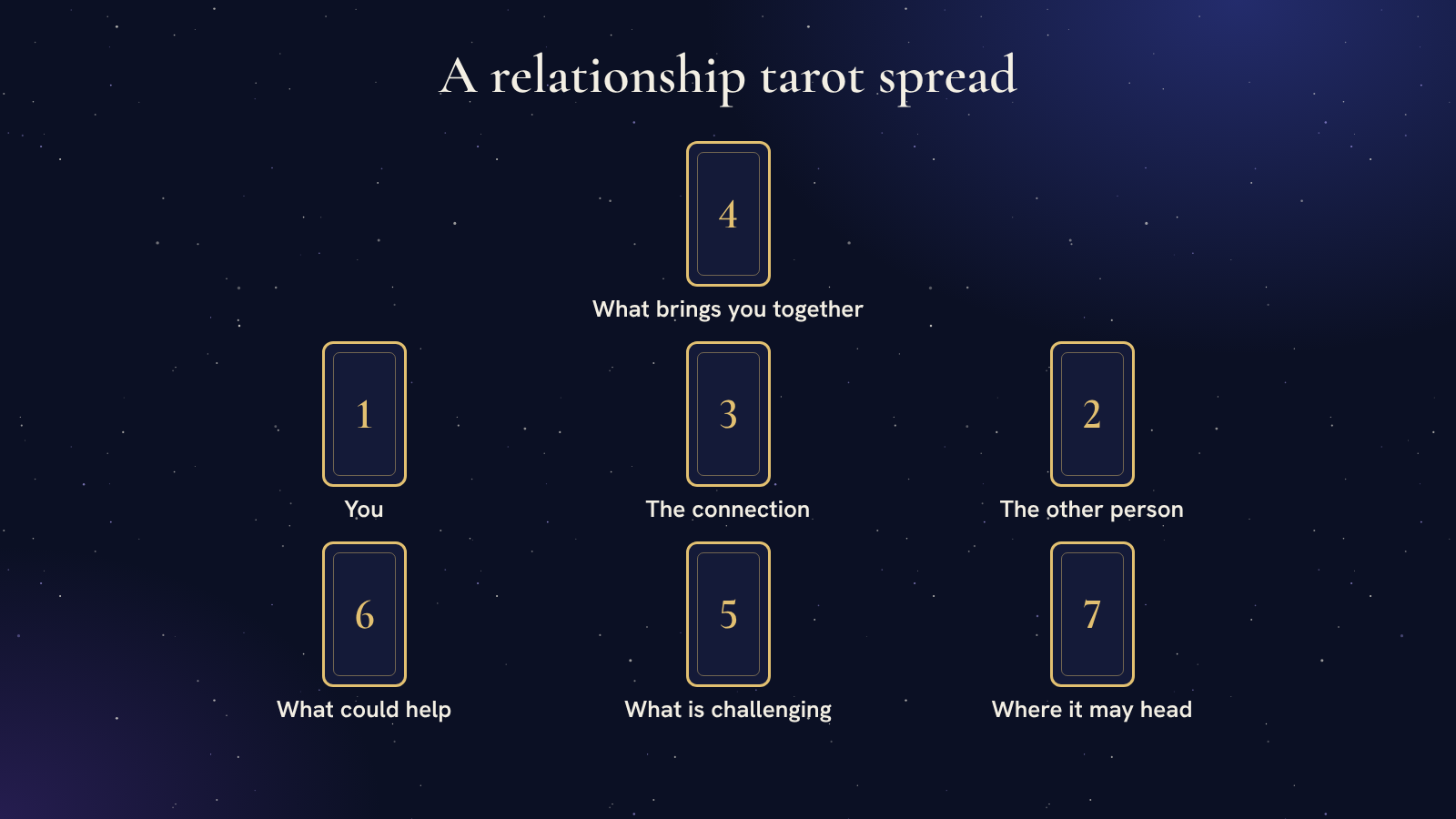
The layout
Card 1 sits on the left and card 2 on the right, facing each other. Card 3 goes in the centre between them. Card 4 is placed above the centre card and card 5 below it, so the cards read as a pull upward and a weight downward. Cards 6 and 7 form a lower row, with 6 on the left and 7 on the right.
Reading the second card with care
Card 2 describes the other person only as you see them. It can't tell you what they think or feel, and it shouldn't be treated as proof of their motives. A good approach is to ask what the card shows about your perception of them, or about what you would like to understand. That keeps the reading honest and keeps it useful.
If the other person is willing, you can also draw the spread together and each respond to the cards. Some find this opens conversations that are hard to start.
Balance across the spread
- Compare 1 and 2. Are they similar or contrasting? Cards of the same suit suggest a shared language. Different suits may show different approaches.
- Read 4 and 5 as a pair. What draws you together and what challenges you are often two sides of the same thing.
- Treat 6 as practical. The "what could help" card often points to something you can do rather than something to wait for.
Before you begin, it is worth deciding how you will treat the cards. Many readers find it helps to decide in advance that no card will be read as a judgement on either person. A difficult card usually points to something that needs attention or care, not to blame.
Questions that suit this spread
- What would help me understand my relationship with my sister?
- How can my partner and I support each other through a busy season?
- What is shaping the way my manager and I work together?
Avoid questions that ask the cards to decide for you, such as whether to stay or leave. The spread is better at clarifying how you see things than at answering a big decision. If a relationship is causing you real distress, talking with someone you trust or a qualified professional is a better source of support than any card.
Tarot has no demonstrated ability to predict events. Readings are for entertainment and reflection only, and they aren't medical, legal or financial advice.
Where to go next
If you are weighing two options rather than examining one relationship, see the two-path decision tarot spread. The Lovers card often appears in relationship readings, and The Lovers to The Hermit explains what it can mean. Once your cards are laid, you can photograph the spread and have it read.