Tarot spreads
The yes or no tarot spread
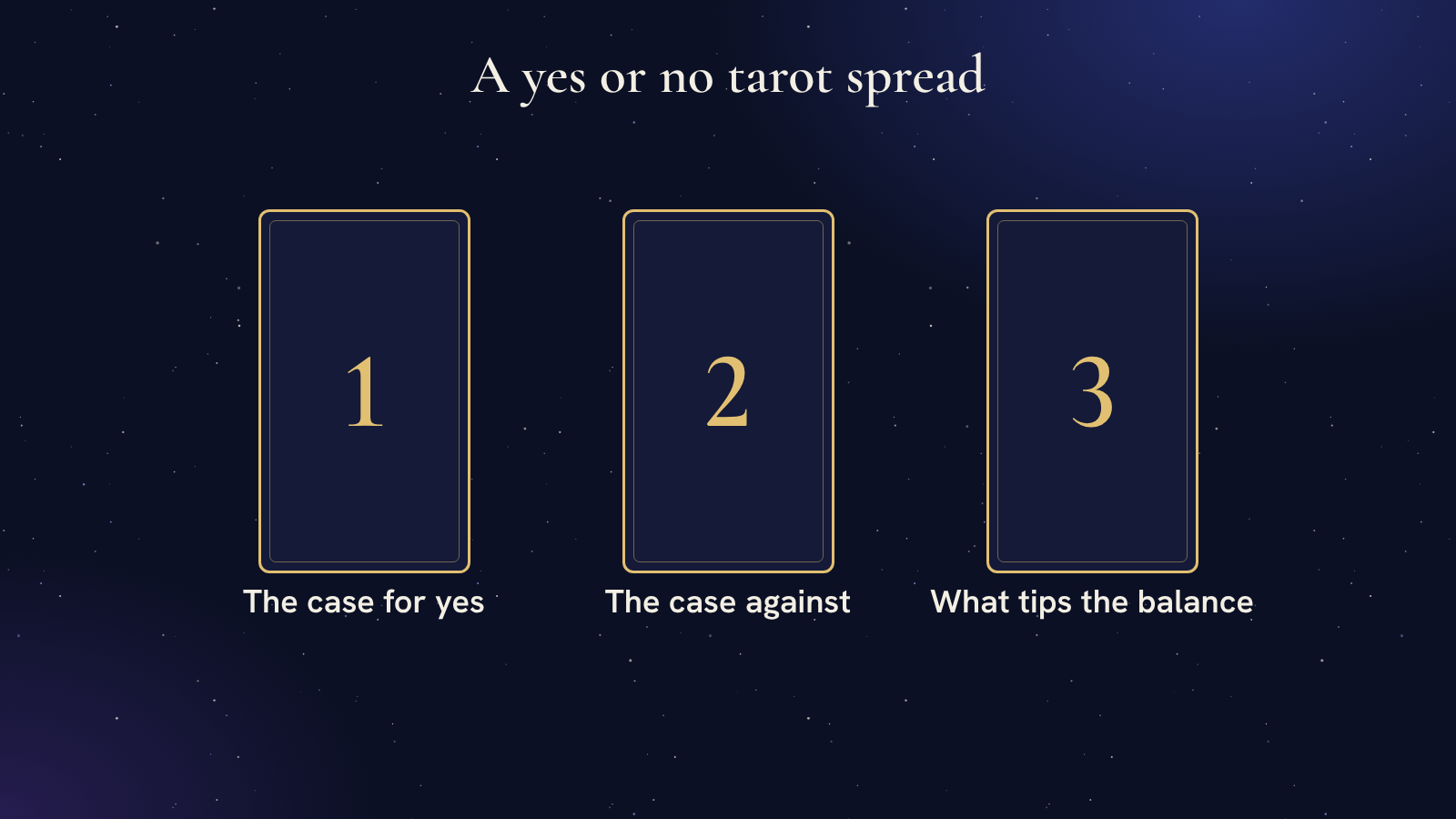
The yes or no tarot spread uses three cards to weigh a decision rather than predict it. It sets out the case for, the case against, and what might tip the balance.
A yes or no tarot spread is a three-card tarot spread for weighing up a decision. Rather than asking the cards to hand down an answer, it lays out the case for, the case against, and what might tip the balance. That makes it more useful than a single flip of a card, and more honest about what tarot can do.
What the cards can and can't answer
Tarot has no way of knowing what will happen, so a card cannot tell you whether you will get the job or whether a plan will work out. What it can do is give you something to react to. Often a person already leans one way, and seeing a card in the "for" position or the "against" position brings that lean into the open. The spread is a thinking tool, and the decision stays with you.
The three positions
- The case for yes. What speaks in favour of going ahead? Think of strengths, hopes and what you stand to gain.
- The case against. What gives you pause? Think of risks, costs and anything you have been avoiding.
- What tips the balance. What factor, value or piece of information might decide it for you?
The third card is not a verdict. It is a prompt about what matters most when the first two pull in different directions.
Framing the question
A good yes or no question is specific and within your control. "Should I apply for the role in the new team?" works well. "Will my manager like me?" does not, because it asks about someone else and about the future. Before you shuffle, try these checks:
- Is the question about a choice you can actually make?
- Is there one decision in it, rather than three tangled together?
- Could you say it out loud in a single sentence?
If the question does not pass, rewrite it first. A clearer question gives the cards something to work with.
Reading the result
Read the first two cards on their own terms before comparing them. A card that looks cheerful can still sit in the "against" position and say something useful: perhaps the case against is complacency or an easy path that asks little of you. Equally, a hard-looking card in the "for" position can point to a challenge worth taking on.
Notice whether one side feels heavier. Then turn to the third card and ask what it adds. If the cards seem evenly matched, that is also information: the choice may come down to timing or to a value you have not named yet.
A worked example
Suppose the question is "Should I move to a smaller flat to save on rent?" You draw the Six of Pentacles for the case for, the Four of Cups for the case against, and Temperance for what tips the balance. You might read the first as a reminder of fairness and a sensible exchange, the second as a sign of feeling flat or unconvinced about the move, and Temperance as a nudge toward moderation, perhaps a middle path such as a slightly smaller place or a later move. That is one reading among many, and the point is the conversation it starts with yourself.
When to use a different spread
If you are choosing between two options rather than weighing one, the two-path decision spread is a better fit. If you simply want a theme for the day, a single card is enough. Avoid asking the same question again and again until the cards agree with you. If the answer is not what you hoped for, that reaction is worth examining too.
Tarot has no demonstrated ability to predict events. Readings are for entertainment and reflection only, and they aren't medical, legal or financial advice.
Where to go next
To see how the idea of fixed positions works across layouts, read tarot card positions and what they change. For a spread built around choosing between two options, try the two-path decision tarot spread. Once you have laid out your own cards, you can photograph the tarot spread and have it read card by card.